hybrid2.0
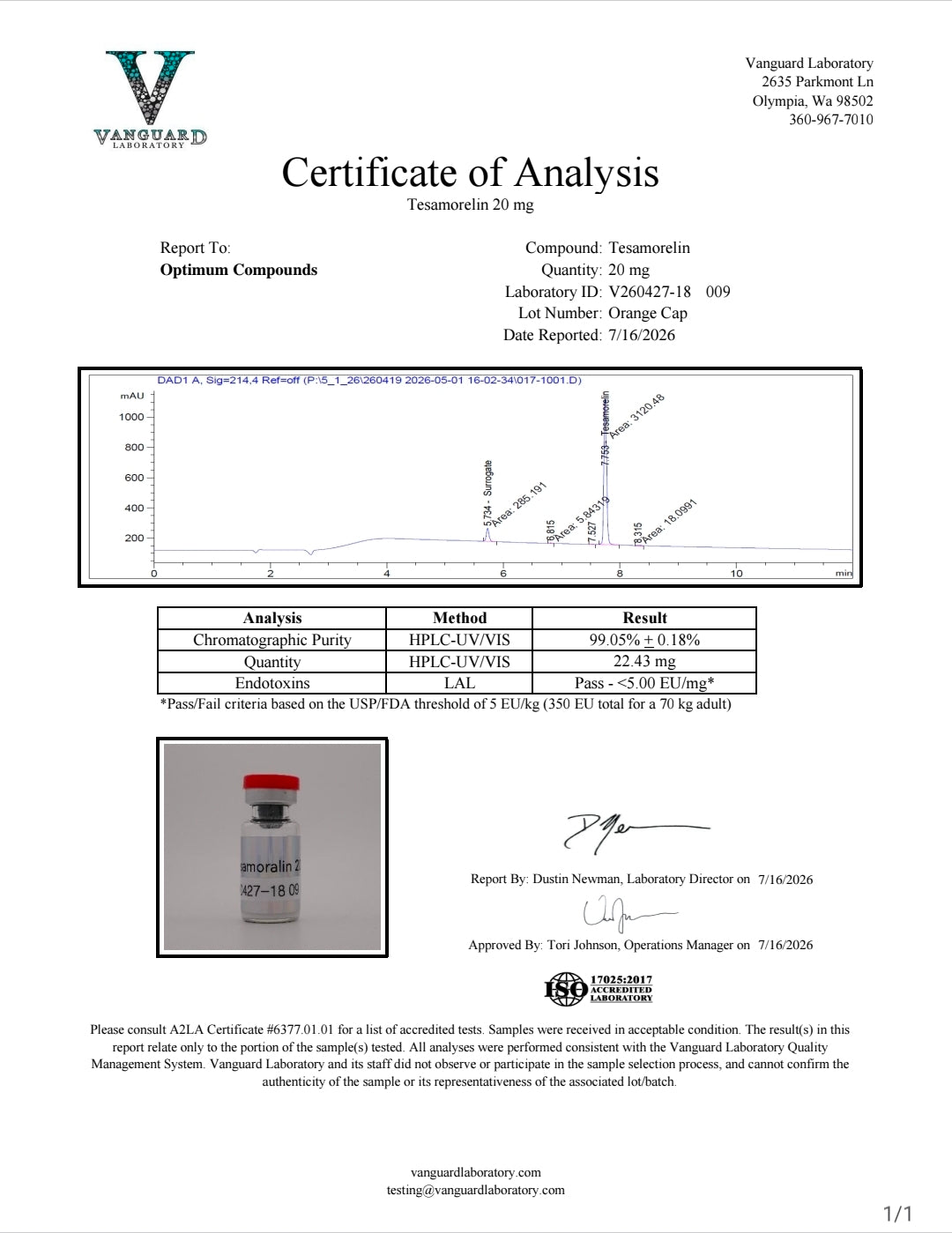
Tesamorelin 10mg vial
Tesamorelin 10mg vial
Couldn't load pickup availability
Tesamorelin
Tesamorelin is a synthetic analogue of growth hormone-releasing hormone (GHRH) consisting of a 44-amino acid sequence. It was designed to mimic the activity of naturally occurring GHRH by stimulating the pituitary gland to release endogenous growth hormone in a physiological, pulsatile manner. Structural modifications, including the addition of a trans-3-hexenoic acid group, improve the peptide's stability and extend its duration of action compared with native GHRH.
Tesamorelin has been widely studied for its effects on growth hormone secretion, body composition, metabolism and visceral adipose tissue, making it an important peptide in both clinical and preclinical research.
Chemical Identifiers
- CAS Number: 218949-48-5
- Molecular Formula: C₂₂₁H₃₆₆N₇₂O₆₇S
- PubChem CID: 16137828
- ChEMBL: CHEMBL1237026
- ChemSpider: 34982925
- DrugBank: DB08869
- UNII: MQG94M5EEO
Mechanism of Action
Tesamorelin functions by binding to growth hormone-releasing hormone (GHRH) receptors located on somatotroph cells within the anterior pituitary gland. Activation of these receptors stimulates the physiological release of endogenous growth hormone while maintaining the body's normal feedback mechanisms.
Unlike direct growth hormone administration, Tesamorelin works by supporting the body's natural hormone signalling pathways, making it a valuable research tool for studying growth hormone regulation and metabolic function.
Areas of Research Interest
Current scientific research is investigating Tesamorelin for its potential role in:
- Growth hormone and IGF-1 regulation.
- Visceral adipose tissue and body composition.
- Metabolic health and glucose regulation.
- Lipid metabolism and liver fat accumulation.
- Healthy ageing and endocrine function.
- Exercise physiology and recovery.
- Sleep physiology and cognitive function.
These remain active areas of scientific investigation, and further research is required to determine their broader clinical significance.
Biological Pathways Under Investigation
Growth Hormone Secretion
Research demonstrates that Tesamorelin stimulates pulsatile release of endogenous growth hormone by activating GHRH receptors within the pituitary gland.
Metabolic Regulation
Experimental and clinical studies are investigating how increased endogenous growth hormone may influence lipid metabolism, glucose homeostasis and energy utilisation.
Body Composition
Researchers continue to explore Tesamorelin's effects on visceral adipose tissue, lean body mass and overall body composition in a variety of experimental settings.
Endocrine Function
Tesamorelin provides an important model for studying the interaction between growth hormone, insulin-like growth factor-1 (IGF-1) and other endocrine signalling pathways.
Current Research Applications
Tesamorelin is commonly investigated in research relating to:
- Endocrinology.
- Growth hormone physiology.
- Metabolic disorders.
- Body composition.
- Healthy ageing.
- Exercise science.
- Recovery physiology.
- Sleep and neuroendocrine research.
These applications are intended for scientific investigation only and should not be interpreted as established therapeutic uses.
Summary
Tesamorelin remains one of the most extensively studied GHRH analogues because of its ability to stimulate endogenous growth hormone release while preserving normal physiological feedback mechanisms. Ongoing research continues to explore its effects on metabolism, endocrine signalling, body composition and healthy ageing. Although published research has produced promising findings in specific settings, additional studies are required to fully understand its long-term safety, efficacy and potential future applications.
Research Disclaimer
For Research Use Only. Not intended for human consumption, diagnosis, treatment, cure or prevention of any disease. Products supplied by Hybrid 2.0 are intended strictly for laboratory and scientific research purposes. Any information provided is for educational and scientific discussion only and should not be interpreted as medical advice or evidence of clinical efficacy.
Share